The problem is not effort.
Good people are usually working around a system that has become too manual to trust.
Analytics cookies
We use Google Analytics to understand which pages are useful and how visitors find us. We only load it if you accept.
Belscar
For growing teams that run on spreadsheets and people's memory: one live place to run the week from. Stock, orders, customers and reporting, built around how your team already works. In weeks, not months.
You talk me through your week. I'll tell you where the hours are going and what I'd build first, then send you a one-page summary.
Prefer email first? team@belscar.com

Client story
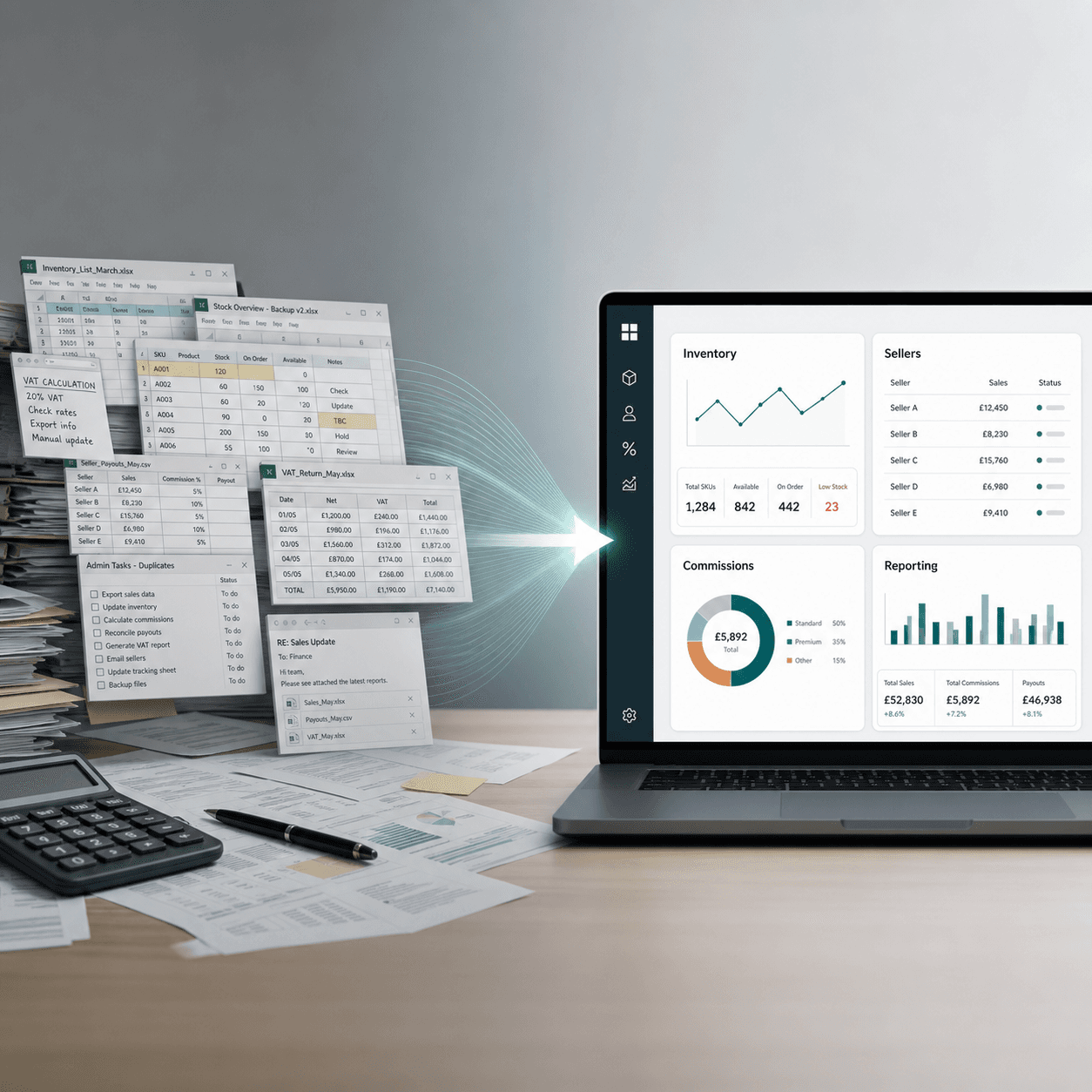
When Luxe Cheshire was growing, the work was being held together by spreadsheets, manual checks and people knowing where things lived.
Stock, sales, customers and reporting all mattered, but there was no single picture of the business. The team spent time reconciling information before they could act on it.
Belscar mapped how the business actually ran, then built a live operating system around that reality. In four weeks, historical data was live, every department had the view it needed, and leadership could see what was happening without the daily chase.
Luxe Cheshire calls it Consignmate, their Company OS. It now runs the operational side of their global business, connected to Xero, Google Search Console, Google Merchant Center, Google Ads, Facebook, Instagram and Klaviyo. Inventory, seller details, sales, commission, VAT and reporting sit in that one place, and the daily reconciliation work has stopped.
The outcome was not “new software”. It was a calmer business: clearer decisions, fewer duplicate checks, and about two hours returned to each person's day.
01 · Before
Spreadsheets and chasing
02 · Build
Map the real work
03 · After
One trusted operating picture
Good people are usually working around a system that has become too manual to trust.
The first job is to understand how work really moves through the business, then build the operating layer around it.
Where complexity shows up
Complexity usually builds quietly: reports take longer, knowledge sits with a few people, and leadership loses confidence in the numbers. These are the patterns we look for before recommending systems, AI, or extra resource.
The symptom
Handoffs slip, reporting takes longer, and leadership has to ask around before it knows what is really happening. The cost is slower decisions and more firefighting.
What we simplify
We identify where complexity is slowing decisions, then simplify the work with better workflows, systems, automation, or AI where it creates a clear benefit.
The symptom
Leadership spends too much time chasing updates instead of making them, reconciling spreadsheets, inboxes, and files while the business waits.
What we simplify
We connect the data and reporting rhythm first, so leaders have numbers they trust before adding AI summaries, alerts, or other support.
The symptom
Critical knowledge sits with a few individuals. Duplicated effort, manual reporting, and fragmented tools get harder to manage as the business grows.
What we simplify
We turn key-person knowledge into repeatable workflows, clear ownership, and practical systems the team can keep improving.
How the work routes
We start with how your week actually runs, then build the one place your team runs it from.
01
You talk us through your week. We tell you where the hours are going and what we'd build first, then send a one-page summary.
02
Start with how the business really runs, not how it looks on paper. Every friction point documented.
03
Replace spreadsheet-led operations with a trusted operating layer, reporting rhythm, and practical automation.
04
The system becomes how the team works. Nobody has to be talked into it.
Proof
“We finally had one operational system the team trusted: one picture of inventory, customers, sales, and reporting without the daily reconciliation grind.”
“Everything we needed landed in one place. Decisions got faster immediately.”
“They mapped how we actually work, then delivered something the team uses every day.”
Where to start
Choose the closest pattern. We'll point you to a sensible first step, and you can talk it through on a 20-minute call.
Question 1 of 2
Pick the closest match.
Useful first steps
If you are not ready to book a call yet, these tools give you a practical read on where complexity is showing up and whether the value at stake is worth a deeper look.
3 minutes
Nine questions, about three minutes. See where the time is going and what we'd fix first.
Start the diagnostic →Business case
Estimate the annual value at stake from manual reporting, reconciliation, duplicated admin, senior time drag, and delayed decisions.
Estimate the value →What we do
Once the constraint is clear, we deliver the practical fix. Most often that means a Company OS: one trusted way for the team to see the work, run the week, and know what needs attention.
Operational systems
When the constraint is how work is captured, connected, or reported, we build your Company OS: a purpose-built operating layer your team runs every week, with joined-up workflows, integrations, reporting, and complementary AI support where it improves decisions or removes manual effort. The result is one trusted view of what is happening, what needs attention, and who owns it. Broader improvement is on our business automation overview.